 PENTECOST SUNDAY

The Spirit is the very life of
God. In the Bible, it is synonymous
with vitality, with dynamism and newness.
The Spirit animated the mission of Jesus and is found at the root of the
mission of the Church. The event of
Pentecost shows forth to us the very heart of the Christian and ecclesial
experience: an experience of new life with universal dimensions.
The
first reading (Acts 2,1-11) is the
account of the event of Pentecost. Here
is narrated the fulfillment of the promise made by Jesus, at the end of Luke’s
gospel and the beginning of the book of Acts (Lk 24,49: “And now I am sending upon you what the
Father has promised. Stay in the city,
then, until you clothed with the power from on high”; Acts 1,5.8: “not many days from now, you are going to be
baptized with the Holy Spirit…you will receive the power of the Holy
Spirit”). With this narration, Luke
deepens a fundamental aspect of the Paschal mystery: Jesus resurrected has sent
the Holy Spirit to the newly born community, empowering it for a mission with a
universal horizon. The account begins
giving some relative indications of time, of place and of the implicated
persons in the event. Everything
happens “when Pentecost day came around” (Acts 2,1). Pentecost is a Jewish feast known as the “feast of the weeks” (Ex
34,22; Num 28,26; Dt 16,10.16; etc.) or “feast of the harvest” (Ex 23,16; Num
28,26; etc.), that was celebrated seven weeks after the Passover. It seems to be that in some Jewish circles
in a later time, in this feast the greatest covenants of God with his people
were celebrated, particularly that of Sinai linked with the gift of the
Law. Though Luke does not develop this
thematic in the account of Pentecost, surely he knew this tradition and it is
probably that he may have wanted to associate the gift of the Spirit, sent by
the Resurrected Christ, with the gift of the Law received on Sinai. In the community of Qumran, contemporary
with Jesus, for example, Pentecost had come to be a feast of the New Covenant
that assured the effusion of the Spirit of God on the new purified people (cf.
Jer 31,31-34; Ez 36). Luke adds: “they had all met together” (Acts 2,1). With this indication, he wants to suggest
that those present are united not only in the same place but also with one
heart. Though a worshipful meeting is
not spoken of, it would not be strange that Luke imagined the believers in
prayer, hoping for the coming of the Spirit, in the same way that Jesus was
praying when the Spirit descended upon him in baptism (Lk 3,21: “Jesus was at prayer….and the Holy Spirit
descended on him”; Acts 1,14: “With one
heart all these joined constantly in prayer, together with some women,
including Mary the mother of Jesus, and with his brothers”).
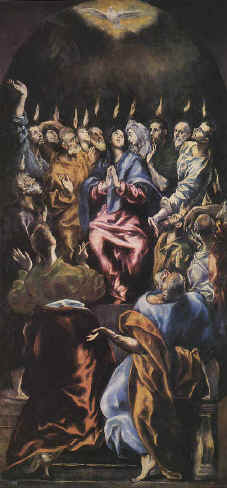
“When
suddenly there came from heaven a sound as of a violent wind which filled the
entire house in which they were sitting” (Acts 2,2). Notwithstanding, the disciples were waiting for the fulfillment
of the Risen Lord’s promise, the event happens “suddenly” and, therefore in an
unforeseen and quick way. It is a way
of underlining that this treats of a divine manifestation, now that the action
of God cannot be calculated nor foreseen by man and woman. The noise arrives “from heaven,” that is to
say, the place of transcendence, from God.
Its origin is divine. It is like
the noise of a burst of a violent wind.
The evangelist wants to describe the descent of the Holy Spirit like
power, like potency and dynamism, and therefore, the wind was a cosmic element
adequate to express this. Besides, as
much as in Hebrew as in Greek, spirit and wind are expressed with the same word
(Hebrew: ruah; Greek: pneuma). It is not strange, therefore, that the wind may be one of the
biblical symbols of the Spirit. It is
enough to think of the gesture of Jesus in the gospel, when “he breathes” on
the disciples and tells them: “Receive
the Holy Spirit” (Jn 20,22), or the vision of the pulverized skeletons narrated
in Ezekiel 37, where the wind – spirit of God re-clothes those bones of flesh
and of tendons, recreating the new people of God.
“And
there appeared to them tongues of fire; these separated and came to rest on the
head of each of them” (Acts 2,3). Luke
uses another cosmic element that was frequently utilized to describe the divine
manifestations of the Old Testament: fire
that is symbol of God as irresistible and transcendent force. The Bible speaks of God as a “devouring
fire” (Dt 4,24; Is 30,27; 33,14); “an everlasting burning” (Is 33,14). Everything that encounters him, as happens
with fire, remains transformed. The
fire is also expression of the divine transcendence’s mystery. In effect, man or woman cannot retain fire
in their hands, always it escapes them; and, nevertheless, fire envelops them
and comforts them with its heat. So it
is with the Spirit: powerful,
irresistible, and transcendent.
The
extraordinary event expressed symbolically in verses 2-3 is made explicit in
verse 4: “They were filled with the
Holy Spirit.” God himself fills with
his power all those present. He does
not comminute to them just any help, but the fullness of divine power that is
identified in the Bible with that reality that is called: the Spirit.
This treats of a unique event that marks the coming of messianic times
and that will remain forever in the very heart of the Church. From this moment, the Spirit will be a
dynamic and visible presence in the life and mission of the Christian
community. “And began to speak
different languages as the Spirit gave them power to express themselves” (v.
4). The interior and transforming strength
of the Spirit, described before with the symbols of wind and fire, becomes now
capacity of communication that begins the elimination of the ancient division
between men and women because of the confusion of languages at Babel (Gn 11). In Jerusalem, not in the house where the
disciples are, not in a close space of some chosen ones, but in the open space
where there are people from all nations (v. 5), in the plaza and street, the
Church reconstructs the unity of the entire humanity and inaugurates the
universal mission of the Church. The
condemned sin in the account of the tower of Babel is the egoistic
preoccupation of men and women that close in on themselves and do not accept
the existence of other groups or other societies, but that desire to remain
united around a great city whose tower touches heaven. The day of Pentecost, the Spirit has come to
pardon and to renew men and women so that tragedies caused by racism, ethnic
closure and religious integration are not repeated. The Spirit of Pentecost inaugurates a new religious experience in
humanity’s history: the universal
mission of the Church. The word of God,
thanks to the strength of the Spirit, will be pronounced repeatedly through
history in diverse languages and will be incarnated in all cultures. The day of Pentecost, the people came from
all parts of the earth and “heard them speaking his own native language” (Acts
2,6.8). The gift of the Spirit that the
Church receives, at the beginning of her mission, makes her capable of speaking
in an intelligible way to all the peoples of the earth.
The
second reading (Gal
5,16-25) describes the new situation of the man or woman that lives “in
Christ,” as a life marked by liberty in the face of the flesh (“egoistic
instincts”) and the law (“all coercion and exterior norm”). The Christian ethic, resp onsible and free,
is rooted in the docility to the Spirit, that is life and love. It is a life in liberty, without being
dominated by the flesh or by any law.
An existence for the service of love.
A liberty that is conserved being guided in every moment interiorly by
the strength and grace of the Spirit.
That which the law asks is
turned into obligation and weight that which is born of the Spirit is
turned into natural manner and spontaneity of action. The works of the flesh and the fruit of the Spirit are not a
simple catalogue of vices and virtues, but some examples that describe
intrinsic visible consequences of the two opposed forms of orienting life. Though the tendencies of the flesh will always
accompany the human being, Paul reminds us that it is possible “to crucify” the
flesh with its appetites and passions; that is to say, to make it that Christ
and the Spirit become the principle dynamic and orientation of all of
existence.
onsible and free,
is rooted in the docility to the Spirit, that is life and love. It is a life in liberty, without being
dominated by the flesh or by any law.
An existence for the service of love.
A liberty that is conserved being guided in every moment interiorly by
the strength and grace of the Spirit.
That which the law asks is
turned into obligation and weight that which is born of the Spirit is
turned into natural manner and spontaneity of action. The works of the flesh and the fruit of the Spirit are not a
simple catalogue of vices and virtues, but some examples that describe
intrinsic visible consequences of the two opposed forms of orienting life. Though the tendencies of the flesh will always
accompany the human being, Paul reminds us that it is possible “to crucify” the
flesh with its appetites and passions; that is to say, to make it that Christ
and the Spirit become the principle dynamic and orientation of all of
existence.
The gospel (Jn 15,26-27; 16,12-15) is made up today by two texts of John’s gospel. The first, (Jn 15,26-27) affirms that the Spirit will give witness to Jesus, first enabling the disciples themselves to understand and accept personally the meaning of their existence and of their mission in the light of Christ, after being strengthened to be witnesses before the world. The second text, (Jn 16,12-15), refers to the Spirit as advocate (“paraclete”) and as master, calling him the “spirit of truth.” The truth is the word of Jesus and the Spirit appears with the mission of “leading to the complete truth,” that is to say, to help the disciples to understand everything said and taught by Jesus in the past, making it that his word may always be living and efficacious, capable of illuminating in every historical situation, the life and mission of the disciples.
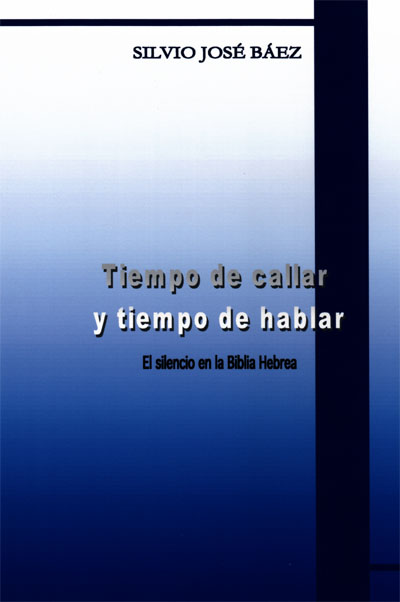
NEW BOOK
Silvio José Báez, OCD, Tiempo de callar y tiempo de hablar. El silencio en la Biblia Hebrea, ediciones del Teresianum, Roma 2000.